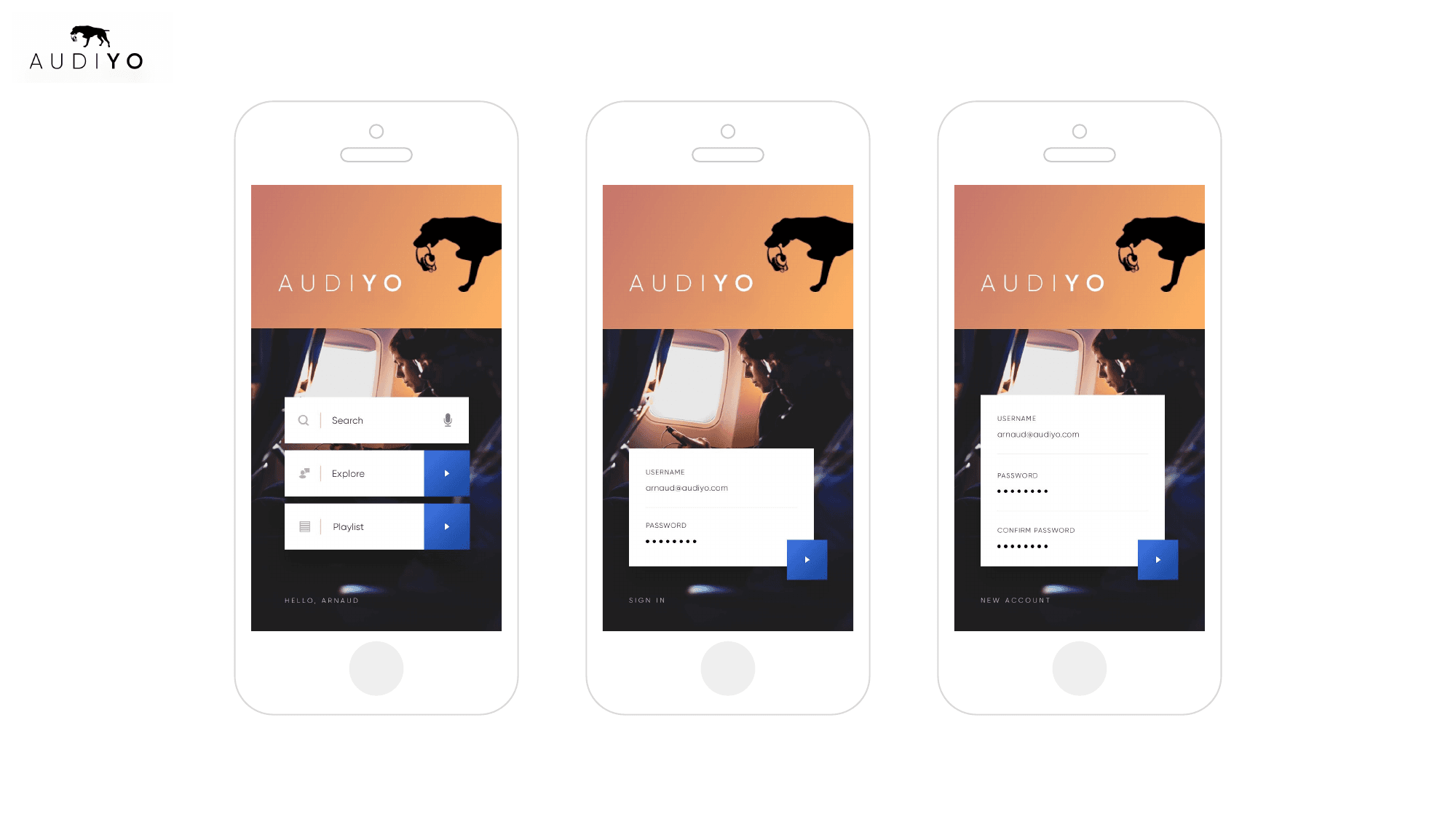
Overview
AUDIYO is a streaming listening service for iOS and Android, with audiobooks, podcasts, and personalized radio stations synced to Google Home, Amazon Echo, and Android Auto. Its key differentiator is gold-standard audio search: rather than matching titles or descriptions, AUDIYO uses NLP to transcribe audio and ML to surface results from the actual spoken content.
3M+
App installs in 10 months
500K
Daily active users
50M+
Episodes indexed
$16M
Funding raised
The Brief
Design Challenge
Audiobooks and podcasting are the fastest-growing audio segments on mobile. Users lose the benefits of folding pages, highlighting, leaving notes, and the nostalgia of physical books. Design a mobile app that is personal, interactive, and brings more utility to the user than a book could.
Constraint: All suggested technologies must exist, or realistically exist within the next 6 months.
Research: Navigation Card Sort
My earliest challenge was structuring audio navigation. With no data to guide the decision, I ran a hierarchical card sort with 4 participants using a think-aloud protocol, to understand how users categorize audio content and what matters most. Feedback was ranked using a mean-point average.
| Category | Rank | Score | User Voice |
|---|---|---|---|
| Searchable | #1 | 1.875 | I don't have to think. Relevant search for listening segments. Strong search results. |
| Explore | #2 | 2.75 | Knows me based on my listening. Predictive recommendations. |
| My Playlist | #3 | 4.5 | The ability to save my listening. I like to re-listen to good things. |
| New | #4 | 4.5 | Listen to something new I haven't heard. Better in the Explore category. |
| Featured Categories | #5 | 6 | Listen to what others are listening to isn't important. |
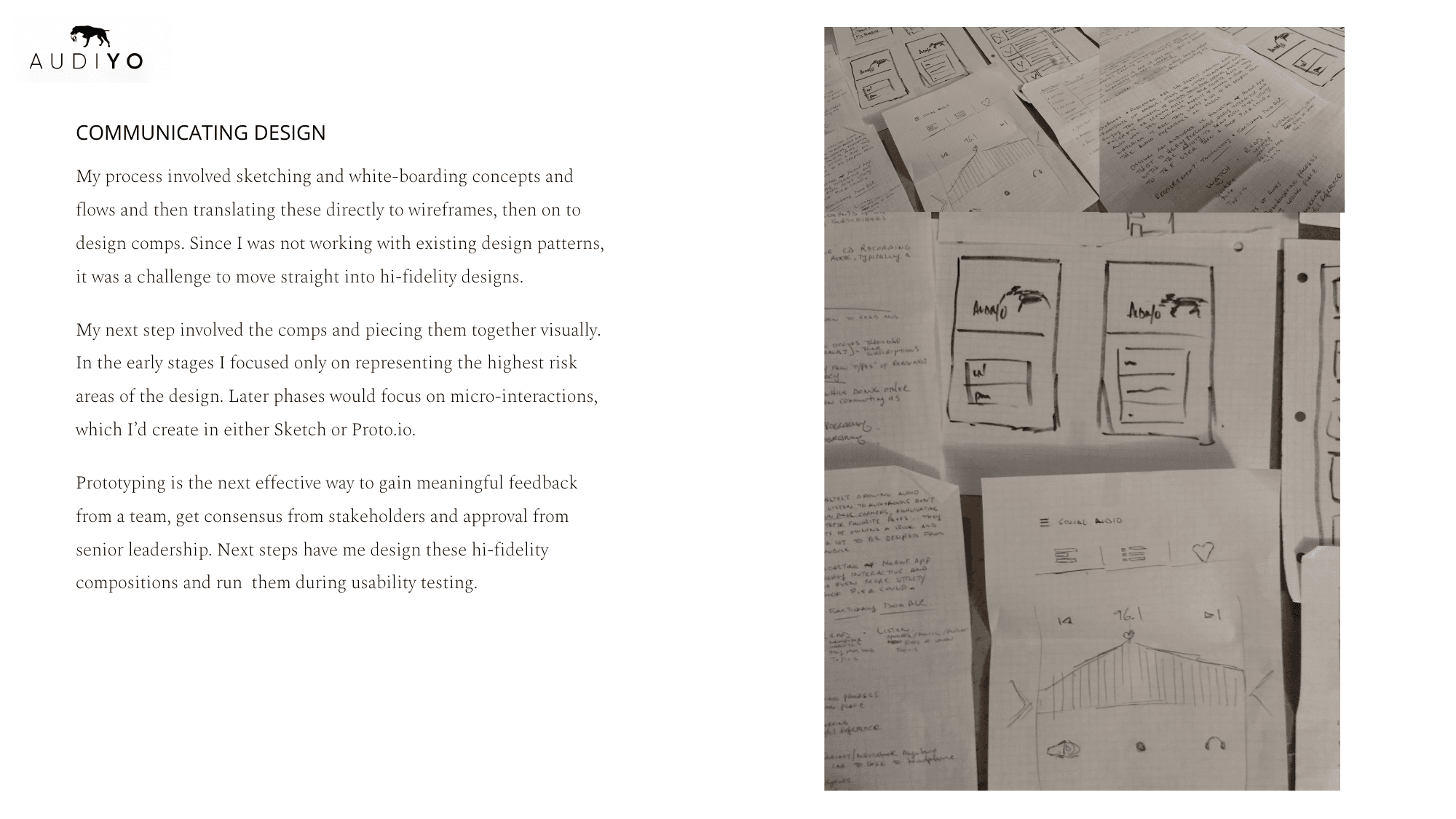
Participants ranked content based on three drivers: predictability, curiosity, and skepticism. The study confirmed a three-node navigation: Search, Explore, and Playlist.
Ideation: The Indie Record Store
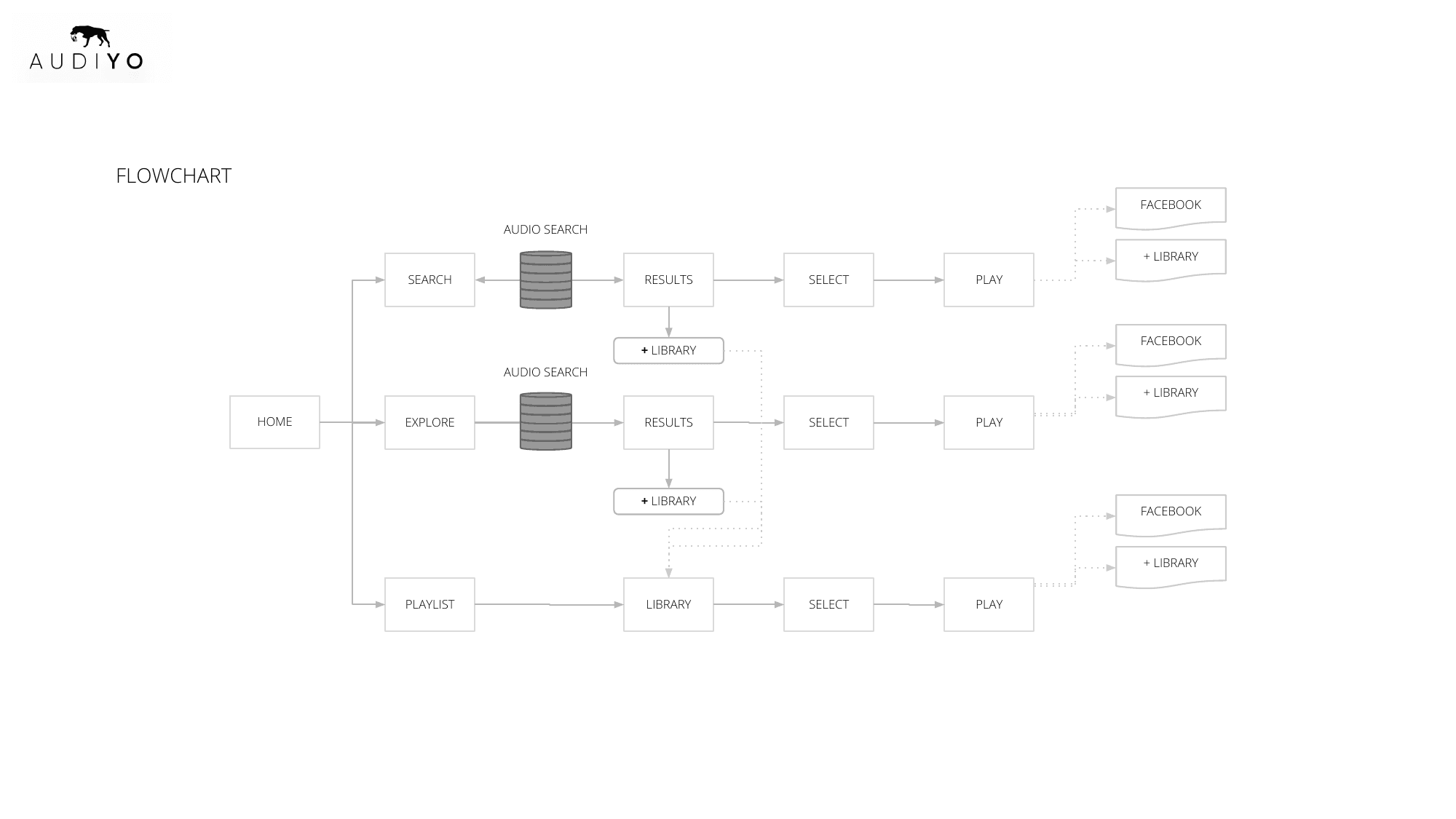
To set the quality bar for search results, I used a polarity reversal technique from Marty Neumeier's Metaskills: Five Talents for the Robotic Age, imagining the worst version of AUDIYO as a "bargain bin" of audio nobody wanted, then mapping the opposite of those traits to define gold standard results.
Design Principles
Before wireframing, I established nine product design principles to anchor every decision, from navigation structure to micro-interactions.
Prove We Know the Customer
Earn honest trust by conversing with customers in ways that are specific, understandable, and actionable.
Personal and Personalized
Listening is deeply personal. Learn and grow with customers over time, making them feel at home and in control.
Do the Lifting
Make sensible decisions and provide intuitive defaults that respect customers' time, data, and attention.
Lead with Meaningful Content
Personalized content trumps all. When we don't know the customer yet, follow fast with curated gold-standard results.
Avoid Dead Ends
Few interactions are meant to be the last. Anticipate the "next interaction", intelligently designed for a customizable experience.
Built for the Go
Low performance is the universal app killer. AUDIYO is built for people on the move with flawless bandwidth connections.
Fit and Finish Matter
Pixel precision, clear copywriting, and delightful details build trust. The product experience is the sum of every interaction.
Design for All Stages
Consider the entire usage lifecycle from Unaware to Passionate, and evolve with customers' listening tastes over time.
Audio Is the Experience
AUDIYO inspires, evokes, and intensifies the customer relationship with listening. Functional and emotional in equal measure.
Process
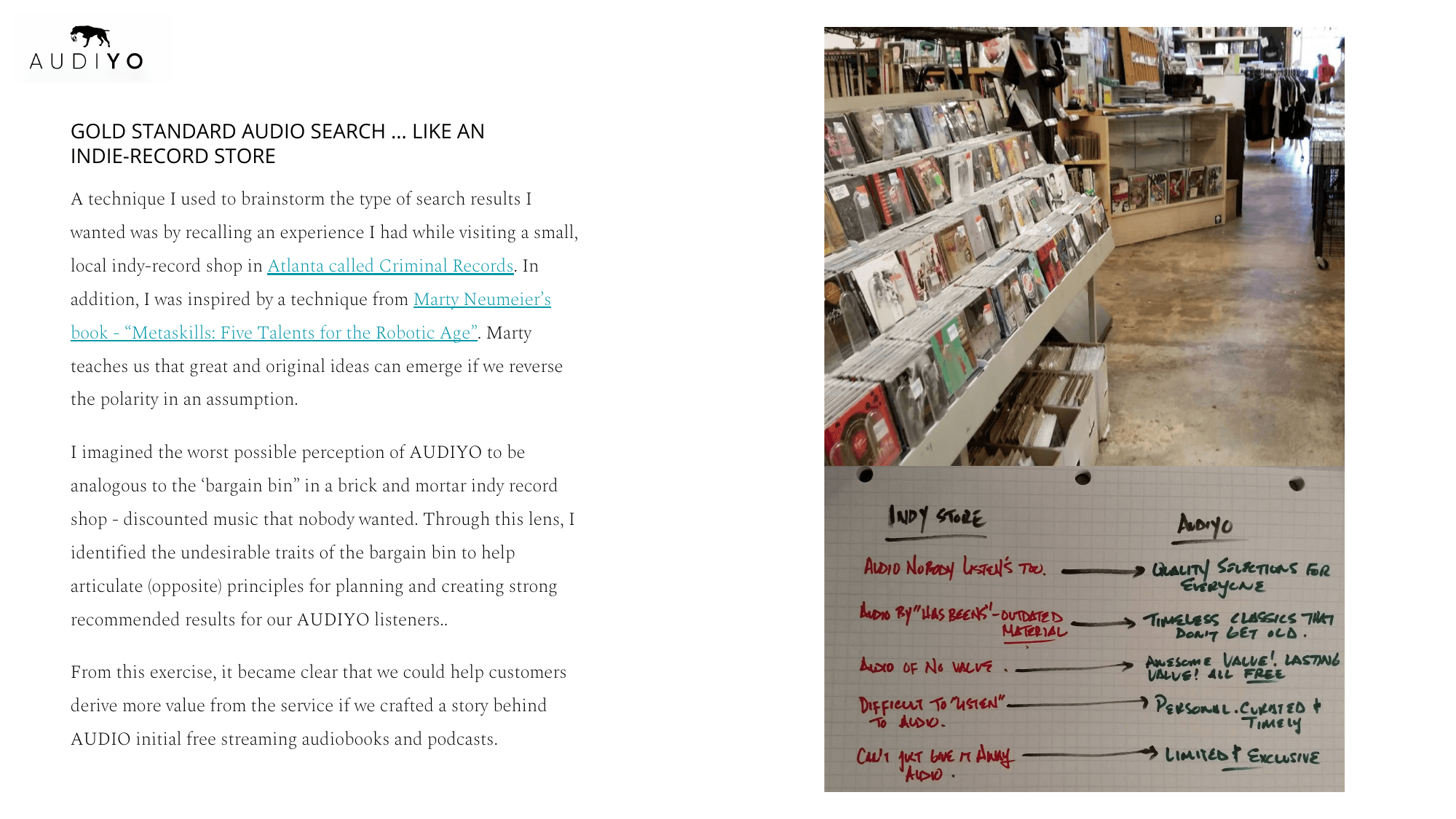
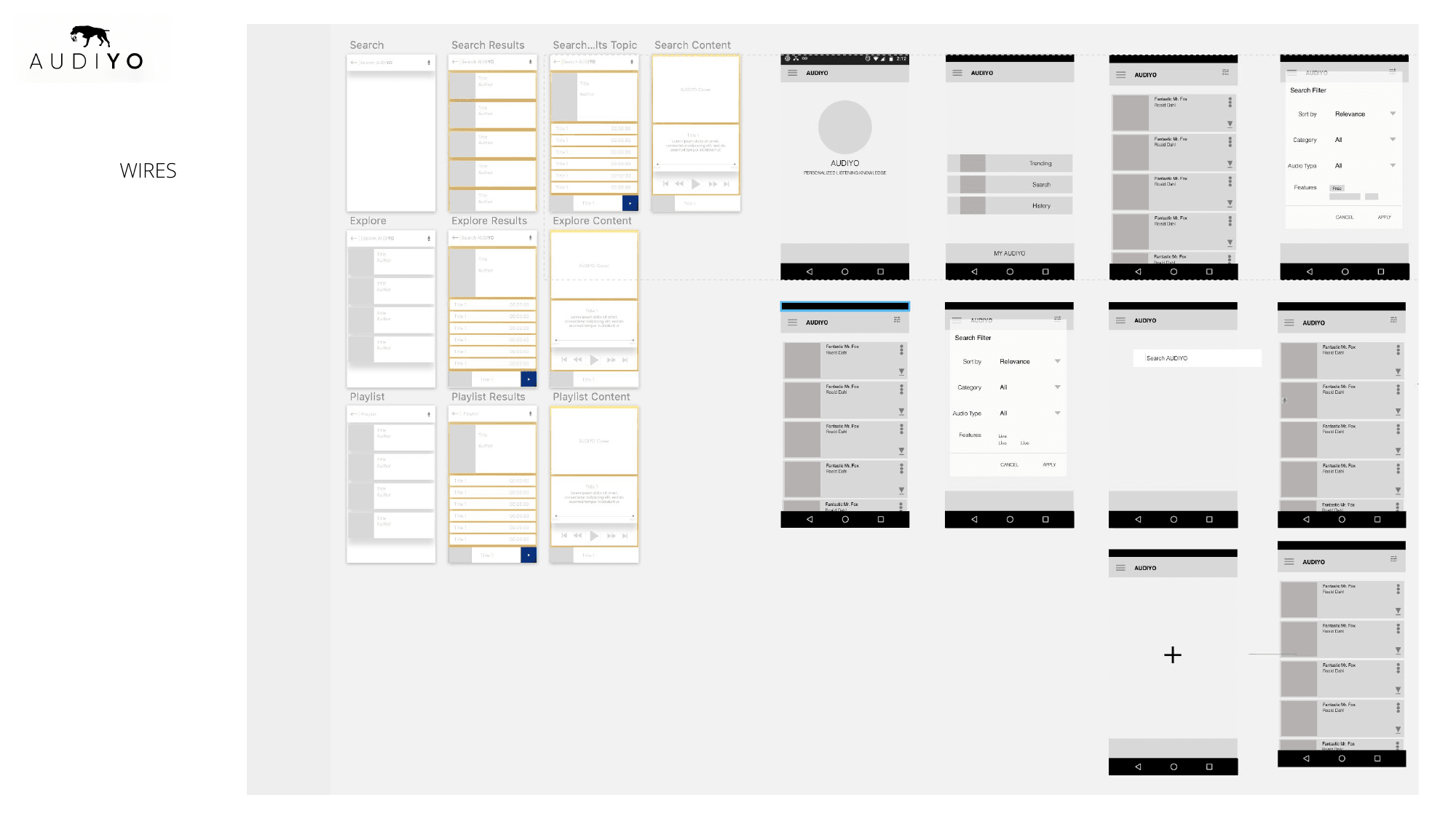
The process moved from sketches and whiteboard concepts to wireframes and design comps: high-fidelity wasn't an option since no existing patterns applied. Early phases focused on the highest-risk areas of the experience; later phases addressed micro-interactions, prototyped in Sketch and Proto.io.
Core Features
Feature 01
Smart Audio Search
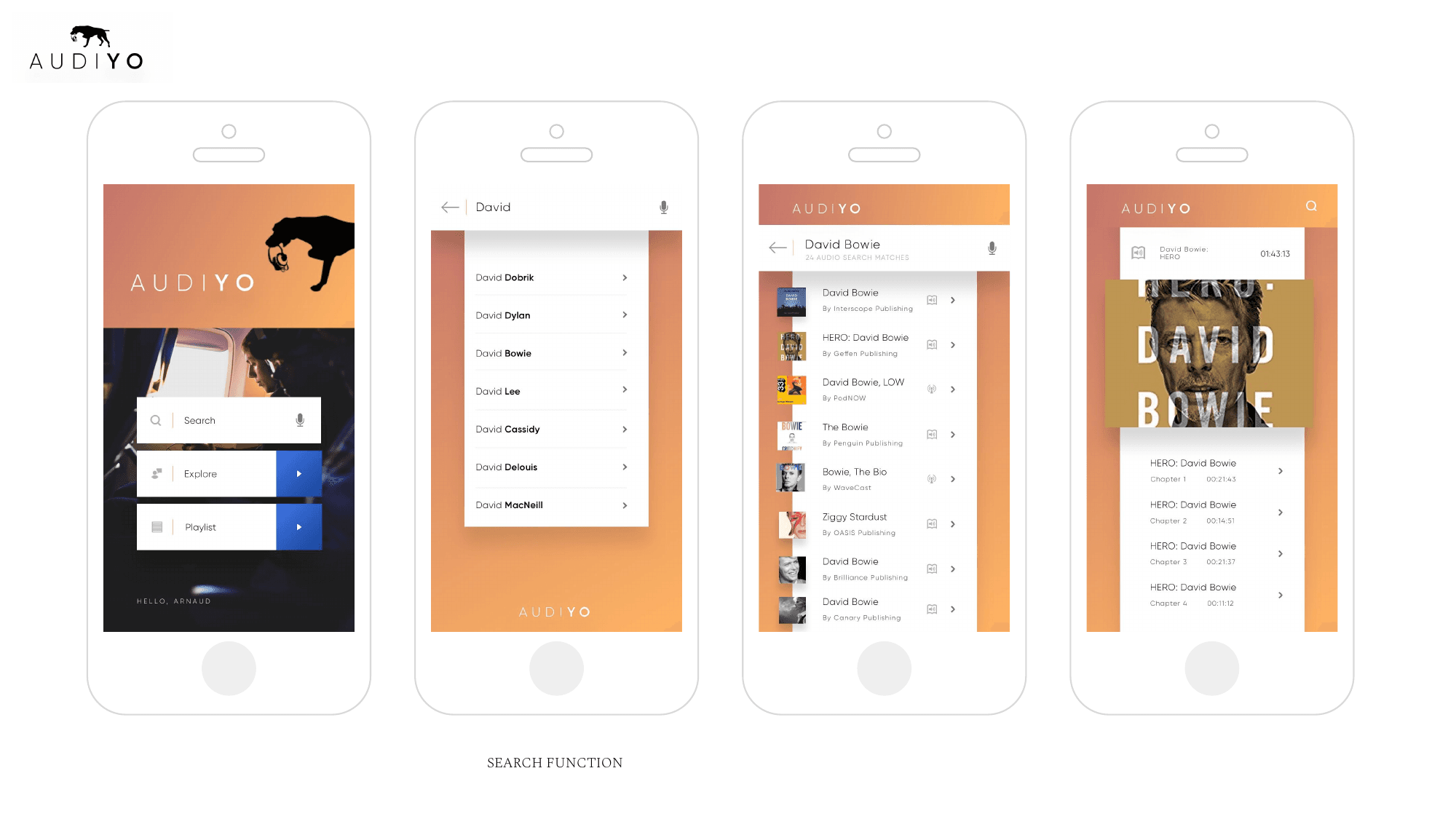
Unlike standard apps that match on titles or descriptions, AUDIYO uses NLP to transcribe audio and ML to surface results based on actual spoken content. Search "David Bowie" and get every episode that mentions him, regardless of the show name.
Feature 02
Explore: Predictive Recommendations
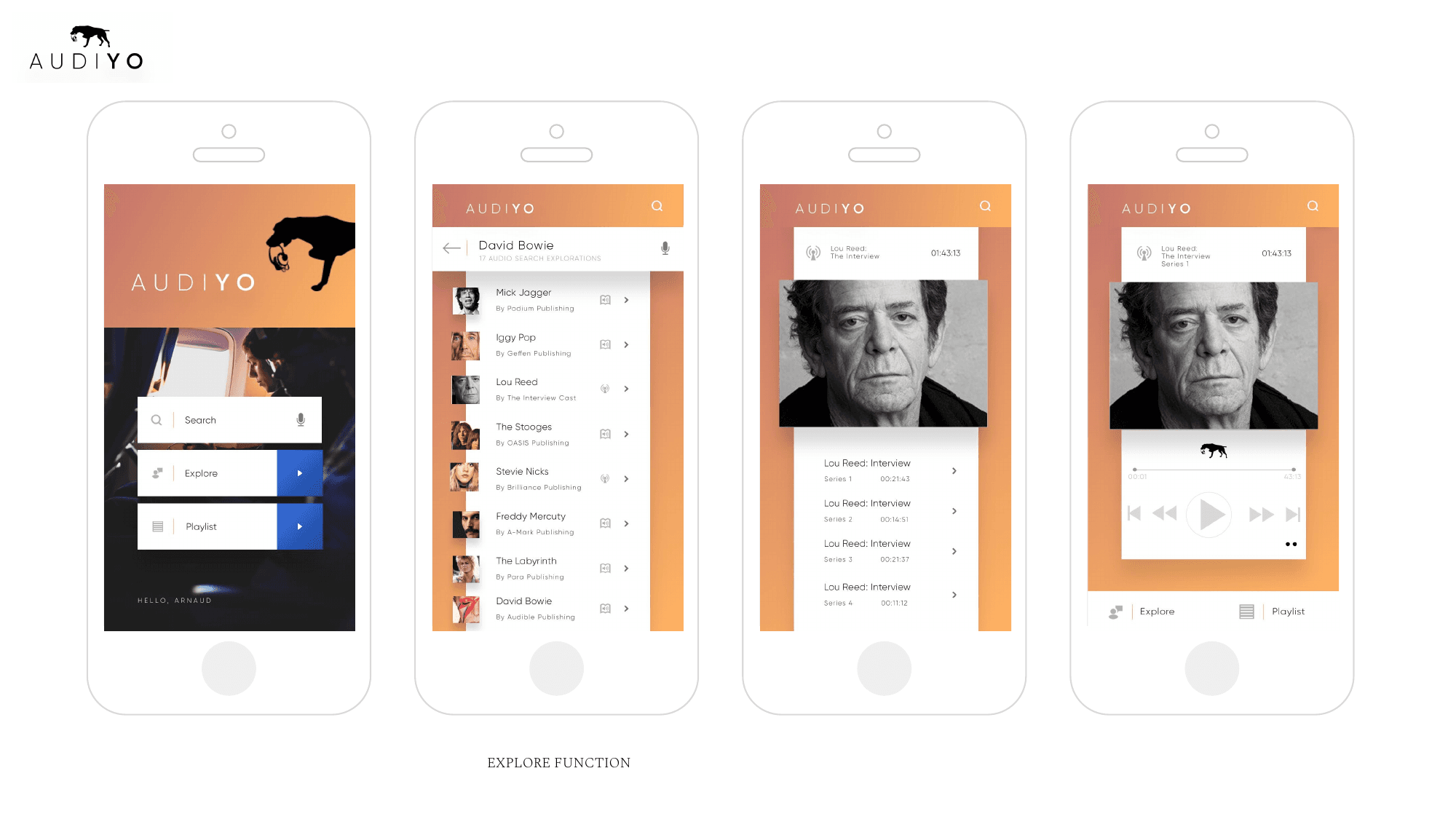
Based on a listener's search and playback history, Explore surfaces contextually related content. A search for David Bowie surfaces Iggy Pop, Lou Reed, and Mick Jagger. The algorithm learns and evolves with the user over time.
Feature 03
Personalized Playlist Library
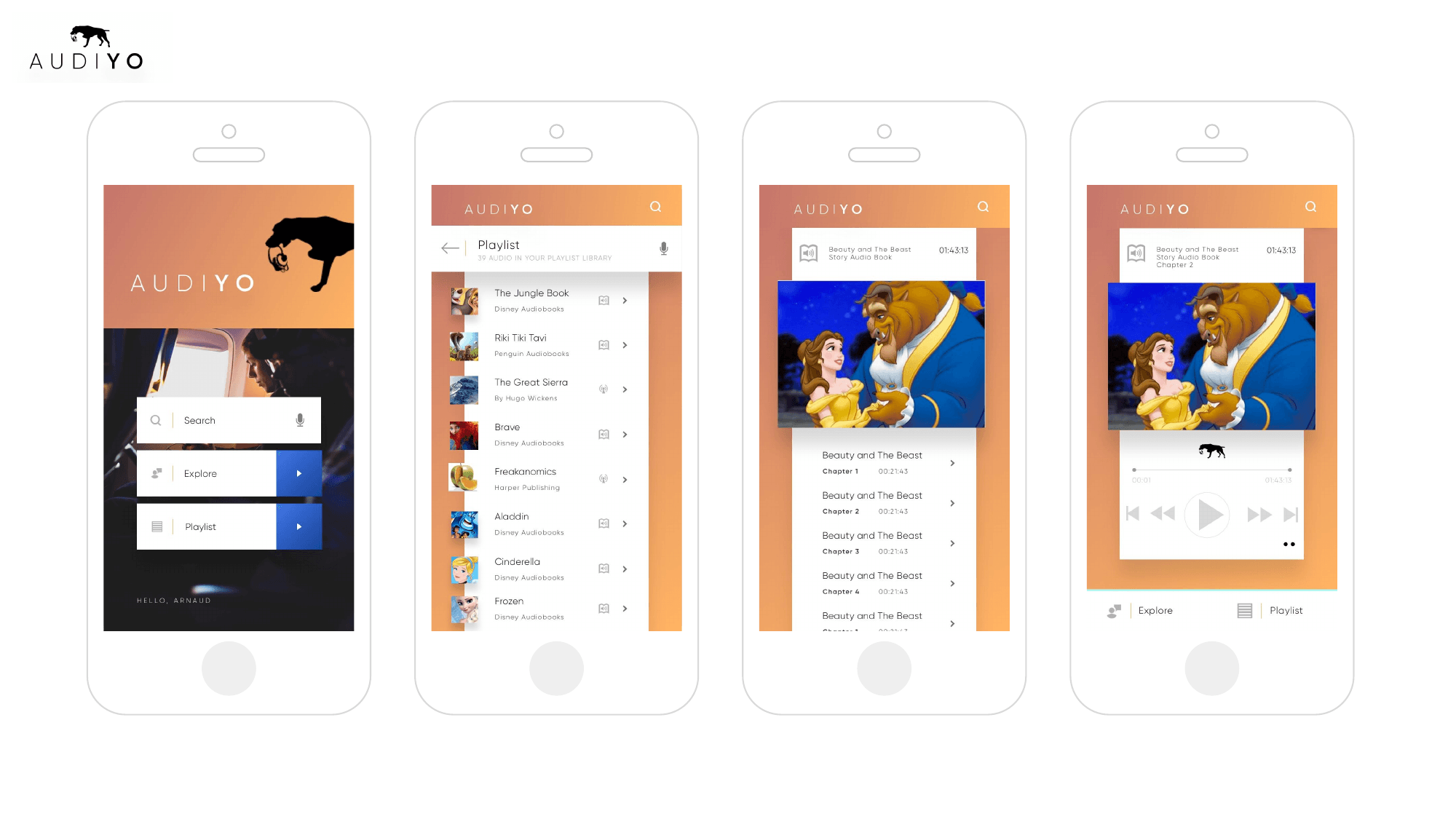
Listeners curate their own library across audiobooks and podcasts, saving individual episodes or full series. Whether a Disney audiobook or a podcast short-story, everything lives in one organized, personal space.
Vision & Next Steps
AUDIYO's vision is to be the simplest, strongest listening service, built on two pillars: Audio Search and In-Stream listening. Post-launch, the roadmap prioritizes continuous iteration, assumption testing through user research, and carefully selected feature releases to keep the product sharp.